Leaderboard

Popular Content
Showing content with the highest reputation on 11/17/2025 in all areas
-
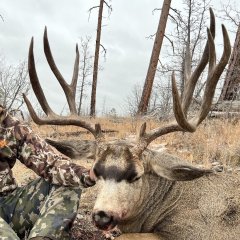
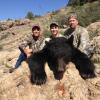
13 pointsGot him on Saturday morning around 7:30.
-
13 pointsBack home and showered. Okay. My two brothers and I put in together for the first time In 15 or 20 years. As luck would have it we got our 5th choice and one of the least popular hunts there is. In August my middle brother doubled up with his son in archery in the unit, sacrificing his muzzy tag. Much cooler moment to double with your son. Fast forward to last Saturday. Sportsmans was having their bubble pop. Me needing nothing thought I would pick up a cheap back up muzzleloader to loan out to friends after I missed a couple of otc elk with it after loaning to a friend. My wife talked me into getting the 45 cal cva with the bergara barrel. We got 50%off on Saturday. Wednesday the ammo came in and I shot 6 or 7 rounds and sighted in. Thursday night I step foot in the unit for the first time In over a year. My youngest brother did not make it down the hill from showlow all the way and spent the night in globe. Instead of doing what I originally planned, 2.5 miles hike up with 1500' elevation gain with my nephew. We decided to go to a spot right off the highway where my middle brother saw some bucks in August. My nephew and I walk a few hundred yards to our vantage point and glass for a bit. We reposition 50 yards down the hill and I hand him my binos and tripod and tell him your my guide find me a buck. I am bored and walk around for five minutes or so. When I walk back I see antlers walking up towards us from below. I push him off the tripod find a couple of bucks and one looked big in the orange light of dawn. I throw my backpack on a rock and set up for a shot. Quartering to me, I settled in and place the crosshairs on his front shoulder and contemplate waiting for him to get closer for a nanosecond and squeeze the trigger. No visible reaction. The buck takes a few steps and disappears. My nephew on the glass says the big buck is going off to the right and I say are you sure he looked like he was walking left. Just then this runt pops out 100 yards below us . i text my middle brother to come to our spot. As we wait i see antlers below us and when he gets there 45 minutes later. I catch a bush moving aggressively. My nephew and I hike down there and find him. My other brother shows up and I now teach two of my nephews how the gutless method. Shot placement was two inches to the right of where I aimed The buck i will post some glamor shots shortly. My brother still has not sent them to me. Should I get it mounted? I have been back and forth on this.
-
9 pointsI will post a story once I get more than one bar of 4g
-
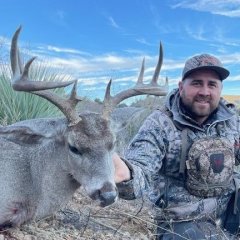
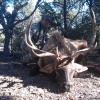
7 pointsGot this one Saturday morning in Unit 28. Taking him to game and fish this morning to get checked in and measured
-
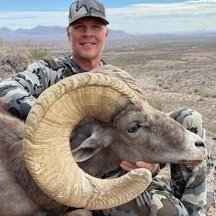
3 pointsLove all the sheep in the background of your pics. Congrats
-
3 pointsMy younger son drew the general rifle hunt tag this year as his 1st deer tag. 2 weeks ago my older son was on the youth hunters in the same unit and the big storms really put a damper on that hunt. The weather for this hunt was much better thankfully. Friday morning was a dud, but Friday evening we sat a blind that we setup a few ago. About 445pm 6 deer walked in. 2 spikes and 4 doe. We were teying to get him settled and setup for a shot on a spike and they were moving and feeding. Either stopping in front of other deer, behind other deer, or at bad angles. After about 5-10 min something kinda spooked then and they went into cover and fed away. Bummer. About 530pm a few doe popped out of another area farther away, then came the 2 spikes. It was the same group. We started positioning on them and from the right 4 more deer fed in, this group had a Forkhorn in the mix, so we started to target him. Again. He wouldn't stop moving or stopped in bad positions. Eventually it got to dark and we had to let them go. Saturday was uneventful other than bumping some does here and there. Sunday morning went like Friday morning. Not alot. Sunday afternoon we set the blind again and the 4 does and 2 spikes fed back in around 5pm. We were able to get my son lined up on a shot at about 200yards. He sent a round and you could tell the buck was hurt bad, but he walked about 30yrds and lied down. We gave him some time, but he was still head up so I had my son send another round. He was hit again, walked about 10yrds and lied down again. After awhile we went over and he expired. It wasn't as clean as you pray for, but it was done. He was a pretty happy camper and I was a happy dad. We quarter him out and got him out of there after dark. You always want a trophy, but this will be his first of hopefully many. So this is trophy #1 with room to grow.
-
3 pointsThat’s pretty much how matco works.
-
2 pointsGot to share youth deer camp with some good friends, with three youth tags in camp. My son had killed a spike last year and was looking for forked or bigger this year. One of the hunters was looking for his first deer and was first up to bat. Opening morning a buddy located a couple small bucks, including a shooter 2x2 with a small forky. They bedded them, and we watched them a few hours, waiting for them to get up and offer a shot. They finally did, and a first deer was harvested! The forky stuck around and even though he was bigger then a spike, my son decided he was too young and let him walk. Day two, another buddy showed us a new area. We worked a ridgeline glassing fingers on the ridges to the east and west. After a mile or so and the 3rd glassing spot, this guy was spotting working up a draw and feeding. We knew he was a shooter in an instant. He wasn’t in a hurry, but sure wasn’t gonna bed for us. He was moving towards a small saddle. He was at 650 yards, and we could maybe shave 200 yards getting to the next ridge but wouldn’t be able to get there before he was over the ridge and gone. It was a now or never type of thing, and the deer was broadside, slightly quartering to. I trust the gun and dope, and my son can shoot. We made sure he had a solid rest, dialed for distance and had him hold for a slight breeze. Kid was cool as a cucumber. At the sound of the shot, the deer hunched and I knew we had a hit, but he ran over the saddle so we couldn’t confirm. It was a long 30 minutes to hike down the one ridge and up the other but we found him about 20 yards from where he was the shot, piled against a tree just over the crest. Entrance was middle on onside shoulder, exit just behind off shoulder. His smile says it all and I couldn’t be prouder! The third hunter is still looking for something special, so send some big buck vibes his way this week!
-
1 pointI have a browning T series Hi-power 9mm pistol for sale in extremely well condition and barely shot. It has the adjustable rear sight and a nice French walnut panel grips, manufactured in Belgium 1968. Now $800. OBO. Text for faster response. Six2three62eight4five 77
-
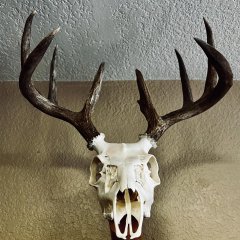
1 pointWas able to connect on a decent little 3x3 175 yards with my CVA Optima this year. Of course after the shot a much larger buck ran out from behind cover, still happy with this guy.
-
1 pointI didnt even notice that.
-
1 pointNice bro! Hope you're able to get back down soon. Keep us posted!
-
1 pointGreat job on the buck. I have a taxidermy addiction so I won't be giving any input.
-
1 pointYou’re the man dude congrats
-
1 pointNicely done. Congratulations. I think mounting should be a "no-brainer" decision. If you have to ask, it may not be worth it for you. It doesn't always have to be a large buck/bull/etc., it can have sentimental value, first buck, only hunt in that state, or whatever. Nothing wrong with a euro mount.
-
1 pointLet's see let's see!
-
1 pointWhitetail hunting was good for us down south. One booner and a smaller but nice representation 85ish for my senior mother. We’re in the middle of 3 Bull elk tags between late archery and 2 late rifle. Then my wife’s late December whitetail hunt. I’ll give an update after new years but the deer hunting has been standard as normal. Grind hard,… and kill good bucks.
-
1 pointTTT for a cool old 22 that needs a new home
-
1 pointMarlin model 8 bolt action 22 that accepts all 22's but not 22 mag. It's pretty old with some light pitting but most of the finish is pretty good. The stock has some nice tiger striped wood. $275 OBO would be willing to trade for 223 hunting ammo or 556 ammo or other guns depending on what you have and I can add cash for the right deal. Call or Text Yancy 602-751-2616 Thanks
-
1 pointCome on you tease
-
1 pointI hope you were able to see the aurora earlier this week. This is what my camera caught here in Flagstaff just before 10pm.
-
1 pointGreat job Zane. And thanks for all the vibes for the 3rd hunter. My son was the 3rd hunter and got it done before the hunt ended on a nice regress 2x4 in velvet. All kids in camp went 3 for 3. Great time with the kids and getting them on deer. Everyone had a blast. Can’t wait to do it again
-
1 pointI simply said from "their perspective" it makes sense financially. I also said it should say so when applying. But that's just me. The guy with unpopular opinions. And I can live with that
-
1 pointI'm amused you think life is fair. Sovereign nation so they can do what they want, at least they didn't take the ops money.
-
1 pointThis is from 1988. SHUFFLE OFF FOR BUFFALO Copyright by Tony Mandile Charles Jones roamed much of the West and Midwest during the late 1800s and the early 1900s. His earned the nickname "Buffalo" because of his skill at hunting the American bison during the time the big animals roamed the plains by the millions. Although Jones isn't exactly a household name, his legacy to Arizona is still quite evident today. At the turn of the century, he decided to introduce elk and buffalo into Arizona, choosing the North Kaibab Plateau as the site for his experiment. Jones planned to sell the hunting rights for both species. He also intended to crossbreed the bison with domestic cattle, winding up with a hybrid animal called either a cattalo or beefalo. Supposedly, these critters would provide the same benefits of beef cattle but would be much hardier, capable of living through weather and on land unsuited to domestic stock. Though the elk transplant never materialized, Jones did bring buffalo to Arizona. Jones and his friend, lion hunter Jim Owens, had captured a herd of buffalo in the Texas panhandle in the 1880s and moved them to Kansas. Later, part of the herd wound up in Monterey, California. Jones transferred 35 from there by way of Lund, Utah to the North Kaibab in 1905. He brought another 87 from the Kansas herd to Arizona a year later. Jones eventually became disenchanted with raising buffalo and rounded up as many as possible in 1909. He drove the buffs into Utah and sold them. Unknowingly, however, he left some strays behind. These became the property of the Grand Canyon Cattle Company, owned by none other than Jimmie Owens. By 1927, when the state purchased the herd for $10,000, the stray buffs had increased to 98 animals. The herds inhabiting Houserock Valley and the Raymond Ranch, established in 1945, are the descendants of those. According to the historians, the American bison might have existed in Arizona during prehistoric times. In contrast, estimates of their numbers living in the rest of the country during the 19th century often mention billions. In reality a truer estimate would be in the millions. When Lewis and Clark explored westward, they told of masses of buffalo, sometimes numbering more than 20,000 within sight of their wagons. The explorers also related how the huge herds darkened the Great Plains and seemingly made the land look like it was constantly moving. Other accounts tell of the concern the settlers had for their own safety as they occasionally used up several days moving their wagons through a single herd. Before the white man began his move West, the buffalo's only enemy was the American Indian. For them, the big mammal meant survival. The meat from one could feed an entire village for days. The hides became clothing and shelter. Because the buffalo provided these basic necessities of life and were so numerous, the tribes depended on them. They followed a particular herd for months at a time and developed ways to harvest the beasts with the primitive weapons available to them. Stampeding a herd to its death was a favorite technique. Indians on horseback drove the animals off a steep cliff or into dead-end canyons where they systematically dispatched them with spears or arrows. Some Indian hunters covered themselves with a buffalo hide and stalked into the herd or waited patiently for one to come to their imitation call of a calf in distress. Yet, while the Indians used the buffalo to survive, the white man was responsible for its downfall. Expeditions, made up of hunters from eastern America and Europe, came out west with the express idea of slaughter in mind. To them, the final tally of dead bison on the ground was a sign of their success. When train travel across the Great Plains later became a reality, the slaughter continued. While crews laid the tracks for the iron horses, hired buffalo hunters kept them supplied with meat. Usually, they removed only the choice parts and left the rest to rot or as food for scavengers. Once completed, the railroads provided a new sport. Shooting the animals from a slow-moving train turned into the entertainment of choice for westward-bound passengers. Naturally, given the weapons of the day and inexperience of those shooting the large creatures, many buffalo died a lingering death after being wounded. Finally, in the 1870s, a new boom helped put the American bison closer to extinction. With the advent of a revolutionary tanning process, the trade in buffalo hides expanded. The leather was far more durable than cowhide, and the grand buffalo population made it fairly easy to obtain. Both the white man and Indian quickly entered the hide-trading market. While the Indians continued to use the entire buffalo, the white hunters usually removed the hide and left the rest. Most were shipped off to Europe for tanning. In 1884, congress finally passed legislation protecting the buffalo from further damage. Unfortunately, by then it was too late. The slaughter had taken its toll earlier. Already in 1883, few bison remained on the Great Plains. Some historians say the population in the U.S. had dropped below 800. Since than, the buffalo number has increased to about 30,000 in North America. Thanks to Charlie Jones, about 200 now live in Arizona. The first state-authorized buffalo hunt occurred in 1927 at Houserock. The Arizona Game and Fish Department (AGFD), the new custodians for the animals, handed out 17 special permits and took the lucky hunters onto the buffalo range to kill an animal. Every year until 1961, the department allowed the state's sportsmen to cull the excess animals in this way. Although most fully grown bison average between 1,500 and 2,000 pounds, some can weigh 2,500 pounds or more. Consequently, killing one in the field was merely the beginning of the hard work to follow. The animal had to be skinned, quartered and transported back to the ranch headquarters. Considering the weight and bulk of the buffalo, this sometimes was difficult. In 1962, no doubt to ease some of the post-kill chore, the AGFD drastically changed the hunting method. The result was a hunt more appropriately called a "shoot." Each hunter who drew a permit also received a date and time for the "shoot." The department then rounded up the excess animals for culling and placed them in a large corral. Here, the "hunters" waited in three-man relays to shoot in the order their permits specified. The first hunter took his choice of three animals that were moved into the shooting pen. The second killed one of the remaining two buffalo, and the last hunter wound up with the third. A top shooter from the game department served as a back-up if a hunter only wounded his target. For the price of the permit, the AGFD provided the skinning and processing and gave the hunter the head, hide and one quarter of the meat. He also had the option of buying the rest of the meat for the same price per quarter as the permit fee. If he passed, anyone willing to pay the price could buy the meat. In 1973, the corral shoot became the focus of much controversy when the movie "Bless The Beasts And The Children" showed in America's theaters. The AGFD had allowed the filming to take place during one of the hunts. Unfortunately, the filmmakers had shrouded their intentions in a bit of mystery. The final editing made the hunt appear like an inhumane slaughter and raised the hackles of people across the nation. In reality, though truly not a hunt, the procedure was efficient. Dispatching a wounded buffalo was easy, permit holders had a 100 percent success and the harvesting of surplus animals was exact. Because of the criticism, however, the department reacted by returning to the earlier method. Another change came about in 1981. The price of a permit went up, and hunters kept the entire animal. The "Catch 22" was each hunter was responsible for taking care of his trophy; no longer did the department provide skinning and processing. A year later, the first REAL buffalo hunt occurred at Houserock Valley. A permit holder no longer would have a game department employee holding his hand in the field. The entire process of killing a buff and getting it out of the field became the hunter's responsibility. Because fences surround Houserock Ranch to keep the buffalo from roaming across northern Arizona, the hunt sounds quite easy. In fact, it can be very difficult. The ranch encompasses about 60,000 acres, including some rugged hills, deep canyons and large stand of trees. To make matters worst, the Arizona Wilderness Act of 1984 changed a large chunk of the ranch into part of a national wilderness area --- closing it to vehicle use. Thus, a hunter within the wilderness boundaries must either ride a horse or walk. Of course, when he kills a buffalo he must get it out the same way. At Raymond Ranch, the first hunt occurred in 1950. Because of its size --- about 14,700 acres --- all hunts remain like the original one at Houserock; an AGFD employee goes afield with the hunter to help him harvest a buff. Beginning with the 1989 season, nonresident hunters may take part in the state buffalo hunt for the first time. The new regulation limits the number of nonresident permits to 10 percent of the total available in any calendar year. It also stipulates no more than 50 percent or two tags for a hunt number will go to out-of-staters. Fortunately for residents, the nonresident fee might discourage some applicants. The price for an adult bull or any buffalo is $3,750. One specifically for a cow will cost $2,250, and a calf permit will be $1,200. In comparison, a resident pays $750, $450 and $240 respectively. The odds of drawing a tag are not as bad as some people believe. Although the permits usually average about 50 a year, first-choice applicants have about a one-in-six chance of being drawn. Compared to some of the elk and sheep hunts, those are pretty decent odds. Arizona's buffalo population averages about 200, about equally divided between the two ranches. The number of permits normally reflect how many animals must be harvested so the herd remains within the limits their habitat can support. In 1987, the department authorized 41 permits --- 26 at Raymond Ranch and 15 at Houserock. First choice applications numbered 217. Last year, about 300 hunters vied for the 61 permits available for the October season. Although the buffalo population and present day hunting pales compared to what they were a century ago, we should be thankful the magnificent animal still survives. We should also be thankful to Charlie "Buffalo" Jones. Without his folly, the bison, in all probability, never would have set foot in Arizona. ----- 30 -----